
Ameba 0.11.0 - New rules, lint in parallel, GitHub action and more
Ameba 0.11.0 has been released. Here we will go through the main features and improvements which are included to this release. Also, will do benchmarking comparing parallel linting using Crystal’s experimental parallelism and will explain how to use Ameba together with GitHub actions.
New rules
Lint/RedundantWithIndex and Lint/RedundantWithObject
Crystal has several handy methods to iterate over collection together with index/object:
- Enumerable#each_with_index
- Enumerable#each_with_object
- Iterable#each_with_index
- Iterable#each_with_object
They are usually used in places where an extra block argument (index or object) is needed:
collection.each.with_index do |e, index|
  puts e, index
end
However, sometimes after a couple of refactoring rounds, people realize they
don’t need that additional argument anymore and forget to remove that extra call to
with_index (or with_object). Examples:
collection.each.with_index do |e|
  puts e
end

collection.each_with_index do |e, _|
  puts e
end

collection.each_with_object(0) do |e|
  puts e
end
Now, all cases above are reported by Ameba. The suggested way to change it will be the following:
collection.each do |e|
  puts e
end
If your source code is not ready for these enforcements, they can be disabled in .ameba.yml via:
Lint/RedundantWithIndex:
  Enabled: false

Lint/RedundantWithObject:
  Enabled: false
Parallel linting
Crystal started to support parallelism
as an experimental feature starting from 0.31.0. The main intention here is
speed, which is achieved by doing several things in parallel. Ameba has a small set
of rules and enforcements, and in most cases, it takes a couple of seconds to lint
an average shard. However, we still find it useful to parallelize the linting,
especially on a large amount of sources.
We found that the easiest way to run linting in parallel, is to spawn each source into its own channel. And since issues are added to the sources, we don’t have to care about thread safety, because a full set of rules will be running sequentially on each source and in its own thread. So the only thing which is needed, is to wait for the whole inspection on all sources at the end and gather results.
At a high level, it looks similar to this:
channels = sources.map { Channel(Nil).new }

sources.each_with_index do |source, idx|
  channel = channels[idx]
  spawn do
    inspect(source) # run full set of rules
    channel.send(nil)
  end
end

channels.each { |c| c.receive }
In reality, it is a bit more complex and it was simplified just to explain the concept. Let’s do some benchmarking now.
At first, we need to build Ameba using the preview_mt flag and install it manually:
$ make build CRFLAGS="-Dpreview_mt"
$ sudo make install
And then we can try running it on Crystal repo (1449 files for the moment) using different amount of crystal workers:
$ time CRYSTAL_WORKERS=1 ameba --silent # 27.78s user 0.34s system 99% cpu 28.116 total
$ time CRYSTAL_WORKERS=2 ameba --silent # 29.54s user 0.22s system 147% cpu 20.184 total
$ time CRYSTAL_WORKERS=4 ameba --silent # 30.90s user 0.28s system 226% cpu 13.742 total
$ time CRYSTAL_WORKERS=8 ameba --silent # 44.67s user 0.44s system 413% cpu 10.900 total
If you look at the total part, you will find that the max time is 28.116
seconds and the min one is 10.900 seconds. So we were able to run it
almost 3 times faster on 8 workers.
However, the results are not linear to the amount of workers. And that is expected, because our sources (or more accurate, lines of code) are not divided evenly and some workers have to inspect bigger sources and other workers will have to wait until they finish.
Of course, someone can say that we can pre-calculate the LoCs and divide the work more evenly. And it would be true. But that would complicate our implementation a lot. So here we decided to make it as simple as possible and keep the room opened for the future improvements.
At the end, we must say that this feature is fully functional and reliable on Ameba’s side. It was well tested using different formatters, so the end user is free to try it to inspect his crystal code in parallel. We are looking for the best results, keep us posted!
GitHub Action
Ameba GitHub action has been released and the first version has been published to the GitHub marketplace.
The easiest way to use it, is to follow installation instructions:
# Copy and paste the following snippet into your .yml file.

- name: Run Ameba Linter
  uses: crystal-ameba/[email protected]
  env:
    GITHUB_TOKEN: ${{ secrets.GITHUB_TOKEN }}
And here is an example of the workflow with Ameba and Crystal specs:
# Create .github/workflows/crystal.yml in your repository

name: Crystal CI

on:
  push:

jobs:
  build:
    runs-on: ubuntu-latest

    container:
      image: crystallang/crystal

    steps:
      - name: Download source
        uses: actions/checkout@v1

      - name: Run Ameba Linter
        uses: crystal-ameba/[email protected]
        env:
          GITHUB_TOKEN: ${{ secrets.GITHUB_TOKEN }}

      - name: Install dependencies
        run: shards install

      - name: Run tests
        run: crystal spec
Once this is added to GitHub action workflow, Ameba will start reporting annotations in pull requests:
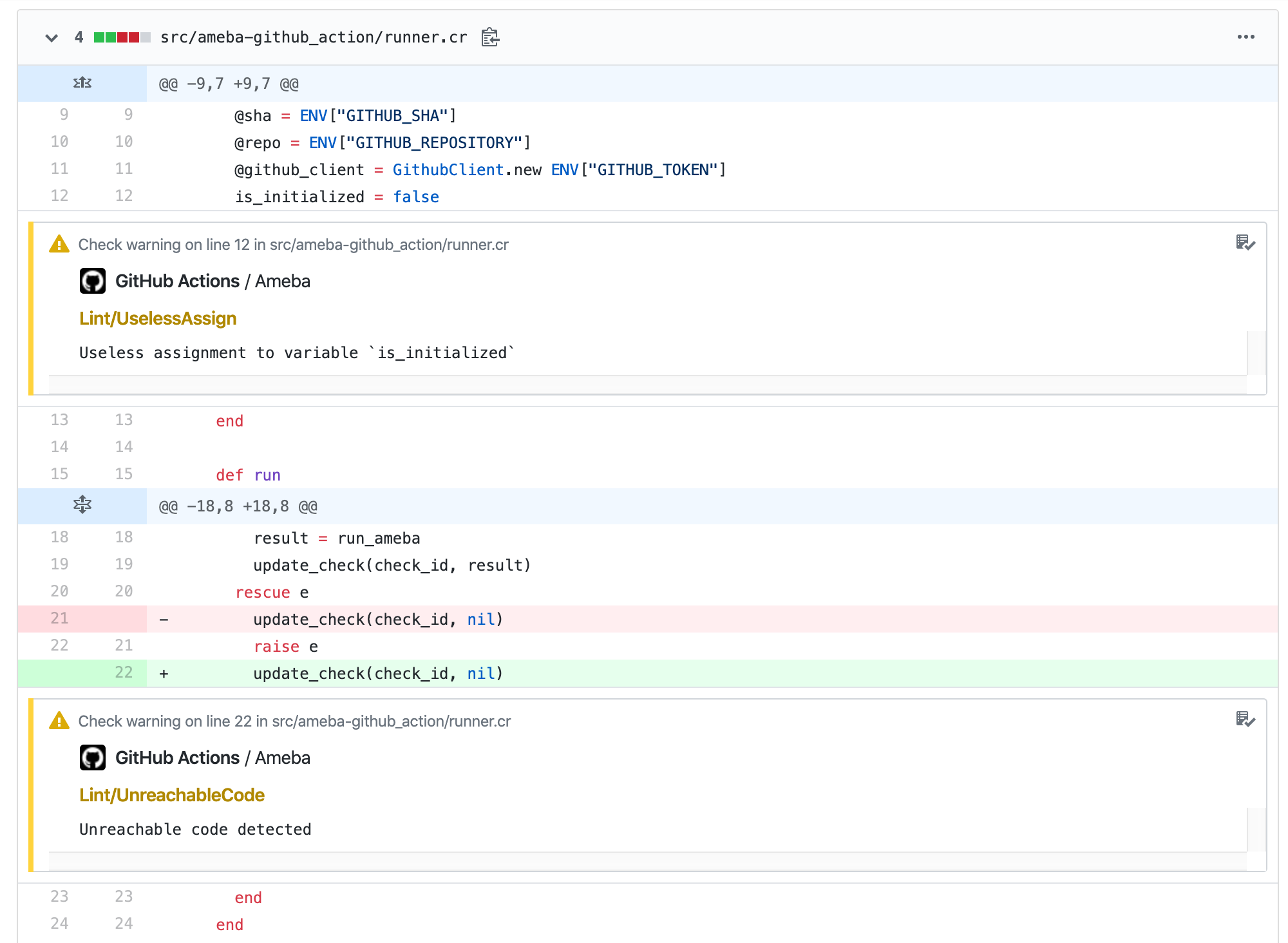
Keep in mind, that is very first release for this GitHub action and it misses a
couple of required configuration options. However, it still uses
.ameba.yml config in the repository root and properly configures rules before
running the inspection. Hope you would enjoy it!
More
This release also includes a couple of bug fixes and small improvements. Check out the release notes for more details.